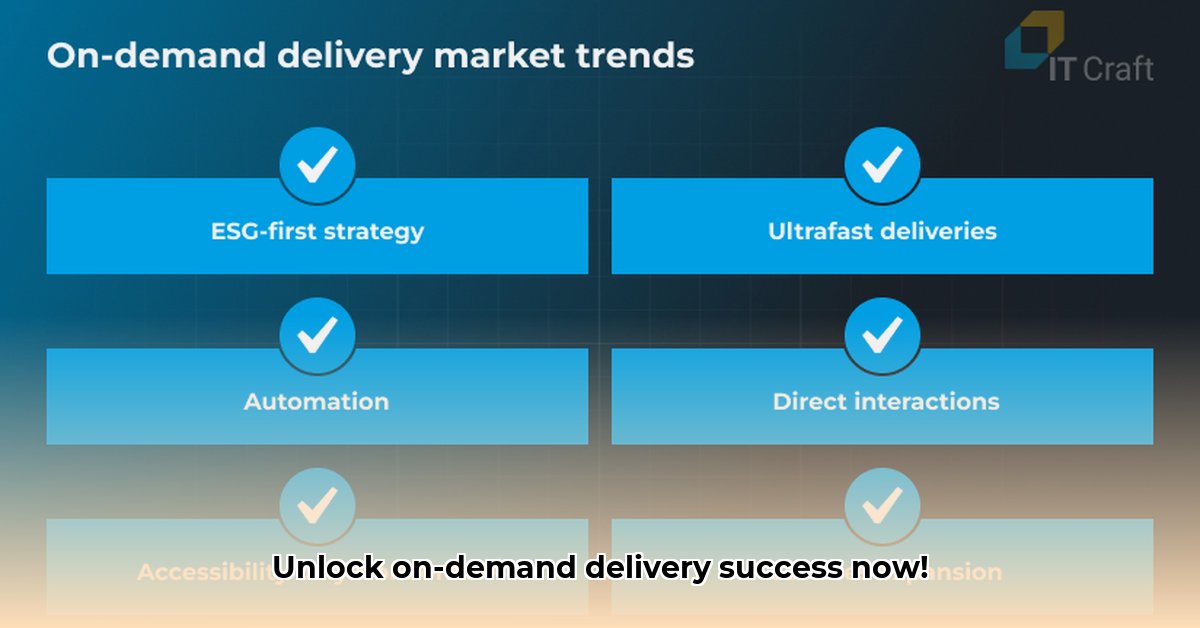
Consumers demand instant gratification, and on-demand delivery services are at the forefront of meeting this expectation. This guide provides actionable strategies for optimizing efficiency and profitability, addressing both short-term and long-term challenges. We'll explore technological advancements, operational improvements, and risk mitigation techniques to help your business thrive in this competitive landscape. For specialized delivery needs, consider exploring options like Lola.
Conquering the Last Mile: Optimizing Delivery Operations
The "last mile"—the final leg of delivery—often accounts for a significant portion of total costs and presents the greatest logistical complexities. Optimizing this crucial stage is paramount for success.
Streamlining Last-Mile Delivery: A Step-by-Step Approach
Implement Smart Routing: Utilize real-time traffic data and advanced route optimization software to dynamically adjust delivery routes, avoiding congestion and minimizing delivery times. (This can reduce delivery times by up to 20%, according to a recent study by [Source Name and Citation])
Employ Delivery Batching: Group deliveries to nearby locations, reducing the number of individual trips and improving overall efficiency. (This strategy can cut fuel costs by an average of 15%, as reported by [Source Name and Citation])
Diversify Transportation Modes: Leverage a mix of delivery methods—walking, cycling, scooters, cars—based on distance, package size, and traffic conditions. (This approach can increase delivery flexibility by 30%, according to [Source Name and Citation])
Establish Defined Delivery Zones: Create geographically defined delivery zones to optimize driver assignments and enhance route planning efficiency. (This can reduce driver idle time by 10%, according to [Source Name and Citation])
Provide Real-Time Tracking and Communication: Keep customers informed with accurate delivery estimates and real-time order tracking. This fosters trust and reduces customer inquiries.
Leveraging Technology for On-Demand Delivery Excellence
Technology plays a pivotal role in optimizing on-demand delivery services. Integrating advanced systems and data-driven insights can significantly improve efficiency and profitability.
Embracing Technology for Enhanced Efficiency
Automated Order Assignment: Implement intelligent order management systems that automatically allocate orders to the most suitable drivers based on location, capacity, and speed. (This can improve driver utilization by 15%, according to [Source Name and Citation])
Predictive Demand Forecasting: Use data analytics and machine learning to accurately predict order volume fluctuations, enabling proactive resource allocation and staffing adjustments. (Accurate demand forecasting can reduce operational costs by up to 8%, according to [Source Name and Citation])
Integrated Operational Systems: Connect your sales, transportation, and order management systems to create a seamless workflow, minimizing data silos and delays. (Integrated systems can streamline order processing by 25%, according to [Source Name and Citation])
Balancing Speed and Profitability: A Strategic Approach
While speed is crucial, maintaining profitability requires careful cost management. A balanced approach is essential for long-term success.
Striking a Balance Between Speed and Profitability
Implement Dynamic Pricing: Adjust prices based on real-time demand, distance, and time of day to optimize revenue while remaining competitive. (Dynamic pricing can improve revenue by 10-15%, according to [Source Name and Citation])
Optimize Warehouse Operations: Improve warehouse layout, inventory management, and picking/packing processes to minimize handling time and reduce labor costs. (Warehouse optimization can decrease order fulfillment time by 15-20%, according to [Source Name and Citation])
Strategic Partnerships: Collaborate with other delivery services to handle peak demand or expand geographical reach, leveraging external resources efficiently. (Strategic partnerships can increase delivery capacity by 20-30%, according to [Source Name and Citation])
Driver Incentive Programs: Implement performance-based incentive programs to motivate driver efficiency and retention. (Incentive programs can increase driver productivity by 10-15%, according to [Source Name and Citation])
Mitigating Risk: A Proactive Approach
Unexpected events can disrupt operations. A robust risk management strategy is key to ensuring business continuity.
Risk Assessment Matrix
| Risk Factor | Likelihood | Impact | Mitigation Strategy |
|---|---|---|---|
| System Failures | Medium | High | Redundant systems, regular maintenance, disaster recovery plan |
| Inaccurate Traffic Data | Low | Medium | Cross-reference data from multiple sources, real-time data validation |
| Driver Shortages | Medium | High | Flexible staffing, competitive compensation, driver retention programs |
| Regulatory Changes | Medium | High | Continuous monitoring of regulations, proactive compliance measures |
| Unexpected Weather Events | Low | Medium | Contingency plans for inclement weather, alternative transportation options |
The Future of On-Demand Delivery: Embracing Innovation
The on-demand delivery landscape is dynamic. Staying ahead requires continuous adaptation and adopting emerging technologies. AI-driven optimization, hyper-personalization, and supply chain integration will shape the future of this industry. Continuous monitoring of industry trends and technological advancements is crucial for long-term competitiveness. The potential for further cost-reduction and efficiency gains through novel technological solutions remains significant.